
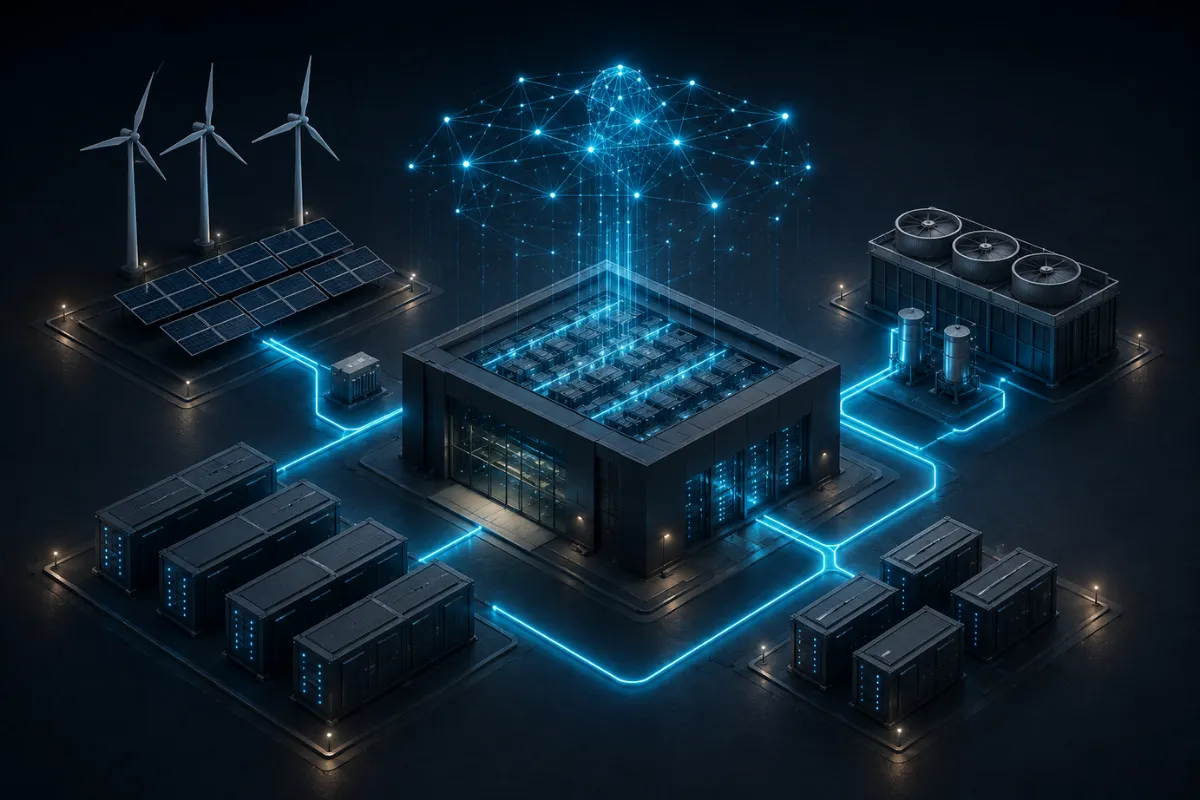
Dynamic Energy Control: How AI Can Orchestrate Energy-Elastic Infrastructure
Infrastructure is becoming harder to coordinate.
AI workloads are growing. Data centres are becoming denser. Electrification is adding new pressure to grid-connected systems. Renewable generation is expanding, but not always where or when demand appears. Batteries, onsite generation, cooling systems and flexible compute are all becoming part of the same operational puzzle.
The challenge is no longer just building more capacity.
It is knowing how to coordinate it.
This is where dynamic energy control becomes important.
Not as another dashboard or a minor efficiency layer, but as the operating intelligence behind energy-elastic infrastructure.
In this context, AI is not just another workload using infrastructure. It becomes part of the control system itself.
Machine learning models can forecast demand, read pricing signals, predict battery performance, optimise cooling, and decide which workloads should run now versus later. Dynamic energy control is where AI stops being only a consumer of infrastructure and starts helping operate it.
From Power Bending to Power Control
Power bending is the ability for infrastructure to expand and contract its energy footprint in response to conditions around it.
Dynamic energy control is what makes that possible.
It is an AI-driven intelligence layer coordinating the grid, batteries, onsite generation, cooling systems, workloads, and price signals in real time. It decides when to draw energy, when to store it, when to use it, when to shift demand, and when to slow non-critical activity down.
Without dynamic control, energy elasticity is just a theory.
With it, infrastructure starts behaving less like a fixed load and more like a responsive system.
That matters because the grid is no longer a passive background utility. The International Energy Agency has warned that grids are becoming a bottleneck in the global energy transition, with connection queues, congestion, and investment delays putting pressure on electricity systems. At the same time, the IEA expects global data centre electricity demand to more than double by 2030, driven heavily by AI.
So the question is not simply: where do we get more energy?
The better question is: how intelligently can infrastructure use the energy already moving through the system?
The Grid Is Now a Signal
Traditional infrastructure treats the grid like a socket.
Dynamic infrastructure treats the grid like a signal.
Price, carbon intensity, congestion, frequency instability, local generation, battery state, and compute urgency all become live inputs that infrastructure can read and respond to.
Dynamic energy control reads those signals continuously and responds.
If solar production is high and prices fall, energy-intensive but non-urgent workloads can ramp up. If the grid tightens during a heatwave, background processing can pause. If onsite batteries are full, the system can reduce grid draw during a pricing spike. If one region becomes constrained, workloads can shift elsewhere.
This is not science fiction. The U.S. Department of Energy already describes grid-interactive efficient buildings as systems that combine smart technologies, distributed energy resources, and demand flexibility to reduce energy costs while supporting grid performance.
Data centres and decentralised compute networks are simply the next, more intense version of that idea.
Batteries Stop Being Backup
For decades, batteries in critical infrastructure were treated mainly as insurance.
They sat there waiting for failure.
That role still matters. But it is no longer enough.
In an energy-elastic system, batteries become active infrastructure. They can charge when energy is cheap or abundant, discharge during peak pricing, smooth sharp demand spikes, support onsite renewables, and help reduce stress on the grid.
A battery is no longer just a backup plan. It becomes a timing tool.
That distinction matters. Energy cost is not only about how much a facility uses. It is also about when it uses it, where it draws from, and how much strain it places on the system at the wrong moment.
Dynamic control turns storage into a strategic lever.
Onsite Generation Changes the Shape of the Load
Onsite energy adds another layer.
Solar, batteries, generators, microgrids, and future distributed energy systems all change the relationship between infrastructure and the grid.
A facility no longer has to behave as a single fixed load. It can become a blended energy system, pulling from multiple sources depending on cost, availability, resilience, and operational priority.
But more energy sources also create more complexity.
The system has to decide when onsite generation should be used, when batteries should charge or discharge, when workloads should move, when cooling systems should pre-condition, and when non-critical compute should pause.
Humans cannot manage that complexity manually at infrastructure speed.
AI-driven optimisation is not a luxury here. It is the coordination layer.
Compute Becomes Dispatchable
The most interesting shift is not technical.
It is conceptual.
Compute starts to look like a dispatchable energy resource.
Not all compute is equal. Some workloads need to happen instantly. Others can wait seconds, minutes, or hours. AI inference at the edge may need low latency. Batch processing, model training, rendering, analytics, and background tasks often have more flexibility.
Dynamic energy control separates the urgent from the flexible.
Critical workloads stay online. Flexible workloads move with energy conditions.
That turns compute into something the energy system has badly needed: responsive demand.
Instead of only building more generation to chase rising load, infrastructure can begin shaping demand around supply.
That is the missing layer.
The Brain Behind Energy-Elastic Infrastructure
Energy-elastic infrastructure needs more than modular hardware. It needs a control layer capable of making thousands of small decisions across cost, availability, resilience, and demand.
Dynamic energy control is that layer.
It allows infrastructure to understand when energy is abundant, when the grid is strained, when storage should be used, when onsite generation should take priority, and when flexible workloads should be moved or delayed.
This is what turns decentralised infrastructure from a collection of distributed assets into a coordinated, energy-aware network.
The winners in AI, data centres, and decentralised compute will not simply be the ones with access to more land, more chips, or more capital.
They will be the ones that understand energy as a live operating condition.
Because the next infrastructure advantage will not come from fighting the grid harder.
It will come from moving with it.




