
Why AI Infrastructure Needs to Think Beyond Megawatts
AI is forcing us to rethink how infrastructure is designed. Every discussion about AI infrastructure seems to arrive at the same conclusion.
We need more power.
More generation.
More transmission.
More substations.
More capacity.
Much of the current discussion is focused on electricity supply, and for good reason.
Power is critical. There is no debate about that.
But focusing exclusively on megawatts risks missing a larger infrastructure challenge that is emerging beneath the surface.
The issue is not simply how much infrastructure we build.
It is how intelligently we design it.
For decades, infrastructure has largely been developed in silos.
Power systems were designed separately from water systems.
Industrial facilities were designed separately from energy infrastructure.
Data centres were designed separately from the industries and communities around them.
Each asset had a specific purpose, a defined boundary, and its own set of objectives.
The AI era is different.
The scale and speed of infrastructure deployment being discussed today is unprecedented. Data centres are becoming larger. Compute densities are increasing. Electricity demand is rising. Cooling requirements are becoming more complex. Water management is attracting greater scrutiny.
As these systems grow, the traditional approach of optimising individual assets may no longer be enough.
The next challenge is optimising the relationships between them.
That shift may sound subtle, but it changes everything.
Consider a modern AI data centre.
The conversation normally begins with electricity supply.
How much power is available?
How quickly can it be connected?
Can the network support future expansion?
These are important questions.
But they are all input questions.
Much of the public discussion focuses on inputs, while the broader opportunities associated with outputs receive less attention.
What happens to the heat generated?
How is water managed?
Can energy be reused?
Can assets support one another?
These questions are rarely the headline discussion, yet they increasingly influence efficiency, resilience, and long-term operating performance.
This is where infrastructure design starts to become more interesting than infrastructure capacity.
Take thermal energy as an example.
Every data centre converts electricity into heat. The larger the facility, the more heat is produced.
In many data centre environments, that heat has historically been treated as something to remove rather than something to utilise.
Cooling systems are designed to remove it and expel it as efficiently as possible.
That approach is understandable.
But it also reflects a linear way of thinking.
Energy enters.
Heat is produced.
Heat is discarded.
End of story.
A growing number of infrastructure developers are beginning to challenge that assumption.
Instead of asking how to remove heat, they are asking whether it can be used.
Thermal Energy Networks are one response to that question. By capturing, transferring, and reusing thermal energy, they create opportunities for infrastructure systems to interact with one another rather than operate in isolation.
The technology itself is not the most interesting part.
The mindset is.
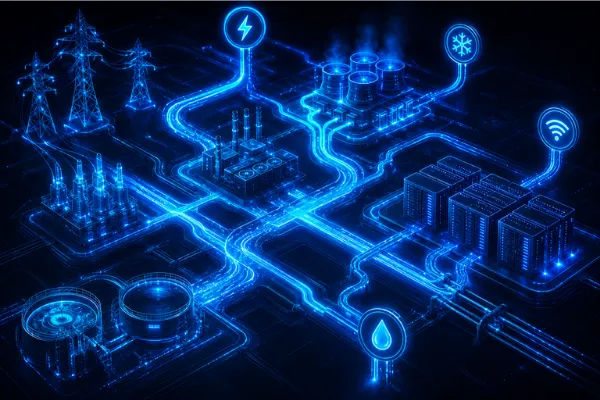
The real shift is from standalone assets to interconnected systems.
The same thinking can be applied to water infrastructure.
To energy storage.
To industrial operations.
To resource recovery.
To utility networks.
Viewed independently, each system has limitations.
Viewed collectively, they create opportunities.
This is not a sustainability argument.
It is an infrastructure argument.
Efficient systems generally outperform inefficient systems.
In some circumstances, integrated systems can unlock efficiencies that standalone assets cannot achieve on their own.
As infrastructure costs rise and resource constraints become more visible, those advantages become increasingly valuable.
The AI sector is still in the early stages of this transition.
Much of today's focus remains centred on securing land, power, and deployment capacity. That is understandable given the pace of demand.
Over time, however, competitive advantage may increasingly come from how effectively infrastructure resources are utilised rather than simply how much capacity is secured.
The most successful infrastructure platforms may be those that extract greater value from the resources already available to them:
Power.
Water.
Land.
Thermal energy.
Industrial capability.
Network connectivity.
Future infrastructure projects may place greater emphasis on how energy, water, thermal systems and industrial activities interact across a site rather than how each asset performs independently.
At TerraX, this way of thinking influences how they consider the relationship between energy, water, thermal systems and industrial activity. The specific technologies will continue to evolve, but the broader opportunity lies in engineering infrastructure systems that create value across multiple resources rather than optimising each one independently.




